
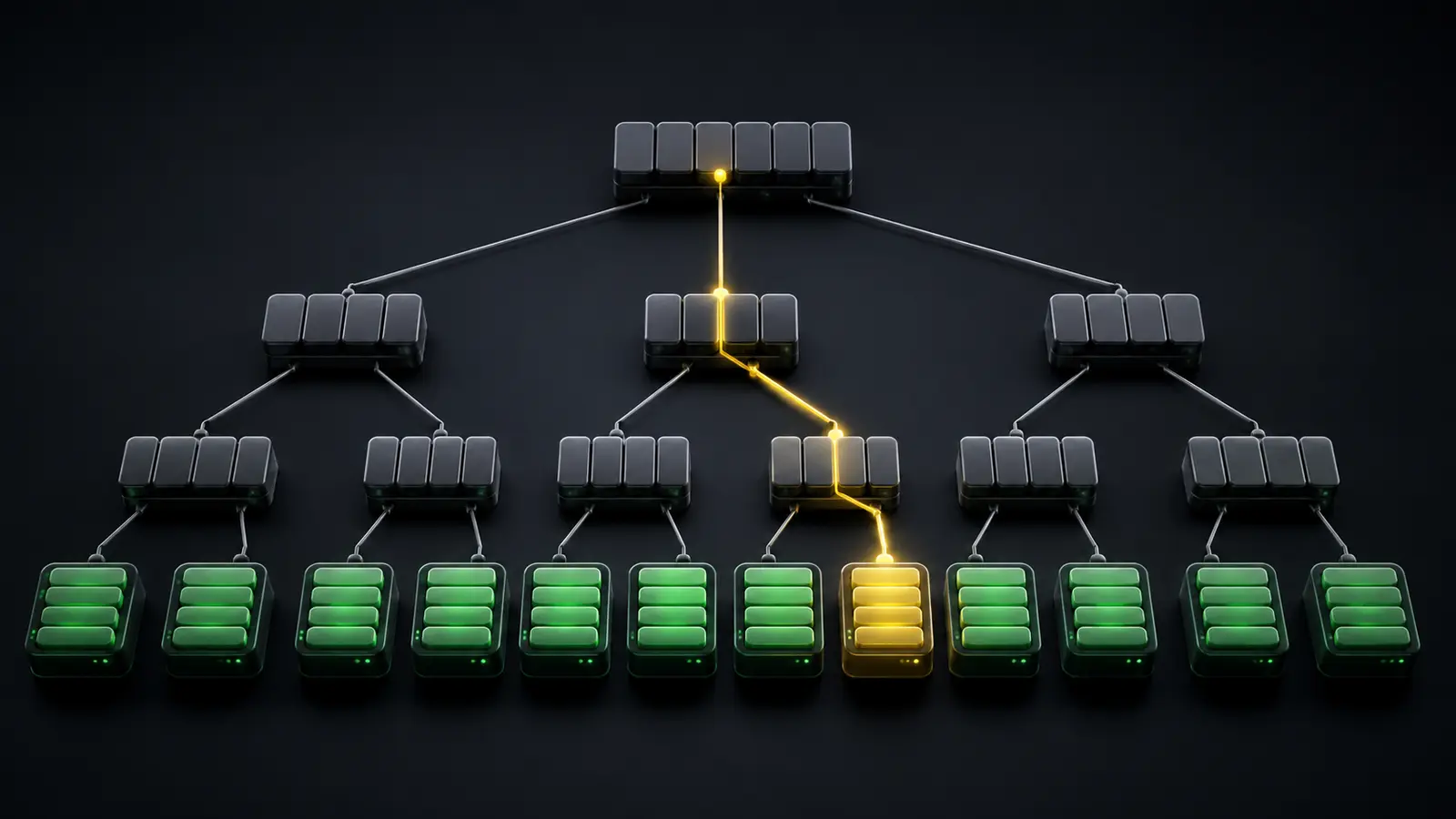
An Index Is A Maintained Search Structure
A database table stores rows, while an index stores selected keys in a structure that helps the engine locate matching rows. A balanced tree commonly supports equality, range, and ordered access. Other index types serve full-text, spatial, array, or large sequential data patterns. The right choice depends on the operator and workload.
The database must keep the index consistent whenever indexed values change. That is why an index is not free acceleration. It trades additional storage and write work for faster eligible reads.
Design From Queries, Not Columns
Start with a slow, important query and its filters, joins, ordering, and returned rows. An index on one isolated column may not help a query that filters by account, status, and date. A multicolumn index can support the combined pattern, but column order affects which prefixes and ranges are useful.
Selectivity matters. An index on a field with only two values may return such a large portion of the table that a scan is cheaper. Partial indexes can focus on active or exceptional rows. Expression indexes can support a transformed lookup, but the query must match the indexed expression.
Indexes also support constraints such as uniqueness. In that case, correctness may justify the index even when read performance is secondary. Keep the data ownership clear when architecture is split; the service boundary guide explains why uncontrolled shared schemas create coupling.
Count Write, Storage, Cache, And Deployment Cost
Every insert, delete, and relevant update changes index pages. More indexes increase write amplification and can reduce throughput. Large indexes compete with table data for memory and may turn a cache-friendly workload into more disk access. They also take time to build, back up, restore, and replicate.
Creating an index on a busy large table can affect locks, I/O, and replication lag depending on the database and method. Plan the operation, monitor it, and know how it will be cancelled or rolled back. Avoid copying a production command from a tutorial without checking the database version and operational mode.
Use Query Plans And Representative Data
Explain tools show how the optimizer intends to execute a query and, when requested, what actually happened. Look at row estimates, scan type, join strategy, sorting, and time. A new index may not be chosen because the table is small, statistics are stale, the filter returns many rows, or a type conversion prevents a match.
Test with realistic data volume and distribution. Synthetic rows with perfectly uniform values may hide skew that dominates production. Compare latency percentiles and system load, not one warm-cache run. If database slowness surfaces as an API timeout, connect the plan evidence with the end-to-end request budget.
| Observation | Possible reason | Next check |
|---|---|---|
| Index exists but scan remains | Low selectivity or small table | Rows returned and cost estimate |
| Fast read, slower writes | Index maintenance overhead | Write rate and redundant indexes |
| Sort still expensive | Order does not match index | Column order and direction |
| Performance changes over time | Data growth or distribution shift | Statistics and real query plans |
Review Indexes As The Product Changes
Collect index usage and query statistics over a meaningful period. Investigate indexes that are large, expensive to maintain, or apparently unused, but remember that rare operational and integrity queries may still matter. Validate before removing one.
Keep schema changes reviewable and document the query they support. The same maintainability discipline applies: record intent, test the outcome, and avoid clever structures no one can operate. When a regression reaches production, use traces and plans within the production debugging loop.
Indexing is not a checklist of columns. It is a measured response to access patterns, balanced against the cost of keeping another data structure correct.
Watch The Index Lifecycle
Updates and deletes can leave dead entries or fragmented pages until the database reclaims space through its maintenance process. Monitor table and index growth, cleanup health, and replication impact. Rebuilding an index may recover space, but it is an operational event with I/O, lock, and capacity consequences.
Review indexes after product changes remove queries or alter filters. An index created for a launch can remain expensive after the feature disappears. Safe removal starts with usage evidence, dependency checks, a reversible change, and observation of both read and write performance.
Common Index Questions
Should Every Foreign Key Be Indexed?
Many join and delete patterns benefit, but database behavior and workload matter. Examine queries and constraint operations rather than applying a universal rule.
Can An Index Make A Query Slower?
The optimizer may choose an inefficient path because of estimates, and extra indexes slow writes. A query plan and workload comparison reveal the actual effect.
When Should I Use A Composite Index?
When important queries repeatedly filter or order by a compatible group of columns. Choose order from equality, range, sorting, and selectivity behavior.