Two Different Ways To Build Behavior
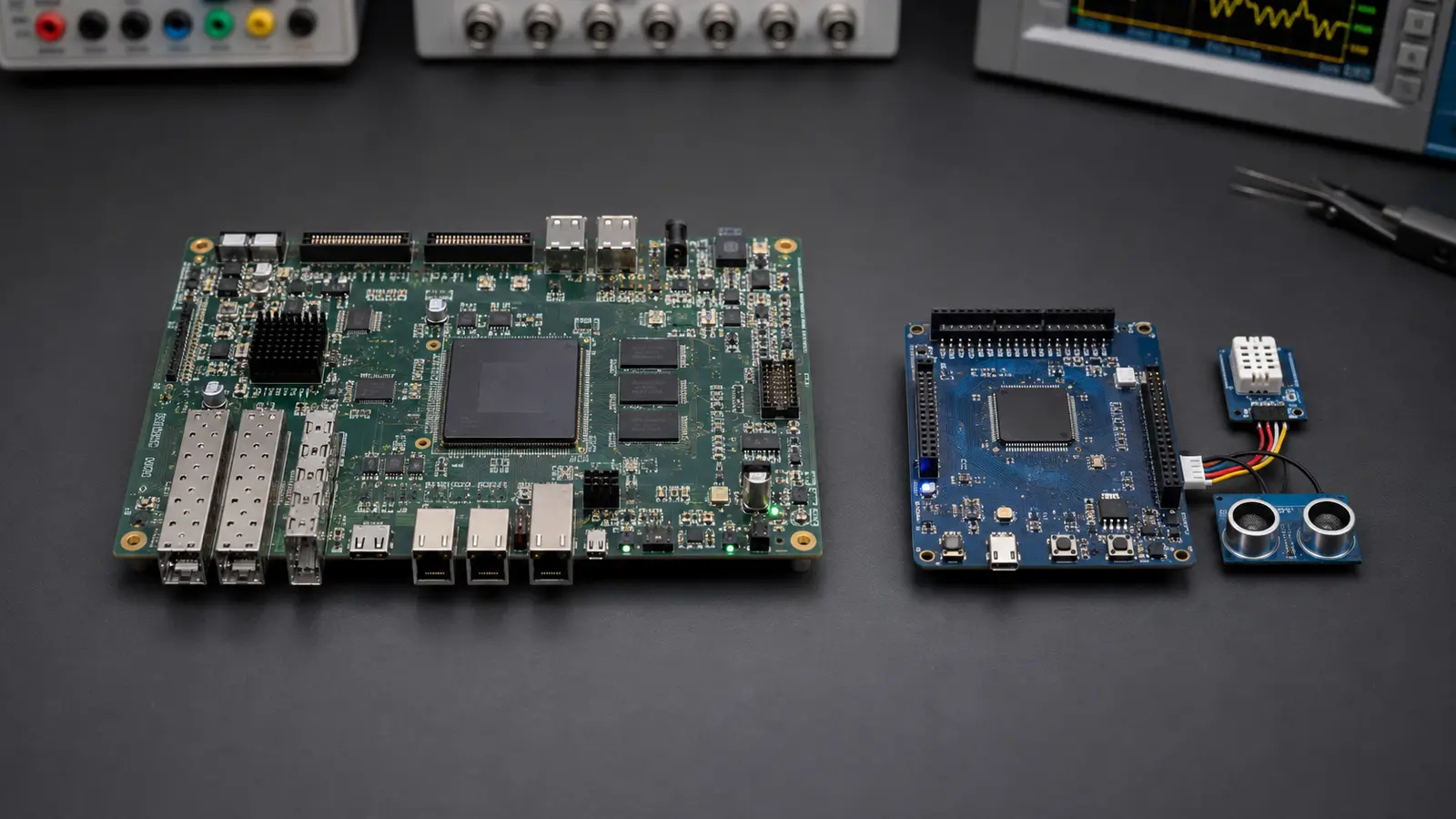
A microcontroller integrates a processor, memory, timers, communication peripherals, and analog features in one device. Firmware executes instructions in sequence, while interrupts, direct memory access, and peripherals handle events around the processor. It is a natural fit for state machines, sensor management, user interfaces, protocols, and moderate-rate control.
An FPGA contains configurable logic elements, routing, memory blocks, clock resources, and often dedicated arithmetic or high-speed interfaces. A hardware description defines circuits that operate concurrently. Ten counters can advance at the same instant because they are ten pieces of logic, not ten software functions waiting for one processor.
Some FPGAs include processor cores, and microcontrollers contain increasingly capable accelerators. The boundary is not absolute. The useful question is which architecture makes the critical part of the system easier to satisfy and verify.
Start With The Workload, Not The Device Category
List data rates, I/O count, latency bounds, arithmetic, memory, control complexity, startup time, power, unit cost, and development constraints. Separate always-on deterministic work from occasional configuration or communication. A device that reads sensors, updates a display, and sends messages is usually comfortable on a microcontroller. A design that captures many synchronized channels and applies the same pipeline to each may favor an FPGA.
Peripheral availability can decide the result before raw compute matters. A microcontroller with the exact timers, converters, and network interface may remove external parts. An FPGA can create custom interfaces and precisely coordinated I/O, but external converters, configuration memory, clocking, and power rails may add board complexity.
Compare Software Deadlines With Hardware Pipelines
Microcontroller timing depends on instruction execution, interrupts, bus access, and scheduling. Well-designed firmware can be highly deterministic, especially when the workload fits comfortably. The guide to real-time systems explains how to budget and measure those paths.
FPGA logic can provide cycle-level latency and parallel throughput. A pipeline may accept new data every clock even though each item takes several stages to emerge. This is valuable for video, software-defined radio, high-speed acquisition, motor-control timing, and custom protocol bridging. It is not automatically easier: clock-domain crossings, reset behavior, timing constraints, and verification become central engineering tasks.
Include Power, Cost, Board, And Team Skills
Microcontrollers often have simple power trees, fast startup, strong low-power modes, and low unit cost. FPGAs can require multiple regulated rails, configuration sequencing, more demanding packages, and higher static power. Device family and workload matter, so estimate the real design rather than assuming one category always consumes more.
Tool flow differs too. Microcontroller teams compile firmware, debug instructions, and test peripheral behavior. FPGA teams simulate hardware descriptions, synthesize logic, place and route the design, constrain timing, and verify the implemented circuit. Build times and tool licensing can affect iteration. The team must understand both functional simulation and physical timing closure.
Board cost can change sharply with package pitch, layer count, memory, and high-speed routing. Review the PCB workflow before selecting a dense FPGA package. A low-cost device that forces an expensive stack-up may not reduce total cost.
| Requirement | Microcontroller tendency | FPGA tendency |
|---|---|---|
| Complex sequential decisions | Natural software implementation | Possible, often more effort |
| Many synchronized I/O channels | Limited by peripherals and service time | Custom parallel logic |
| Very low sleep power | Broad device choices | Family-dependent |
| Custom high-speed pipeline | May need an accelerator | Strong architectural fit |
| Fast, familiar iteration | Often simpler for software teams | Requires HDL and timing expertise |
Work Through Concrete Decisions
Battery Environmental Sensor
A microcontroller is usually the efficient choice because the device sleeps, wakes to sample, performs modest processing, and transmits. The broader IoT network design will likely dominate reliability.
Eight-Channel Precision Pulse Generator
An FPGA may be attractive when channels need tightly aligned edges, independent state machines, and deterministic reaction to external triggers. A microcontroller with advanced timers may still satisfy moderate requirements, so verify the actual resolution and channel count.
Motor Controller With User Interface
A microcontroller can run the feedback controller, communications, and interface when timing fits. A high-channel-count converter or specialized modulation engine may justify FPGA fabric, sometimes paired with a processor.
Protocol Bridge
For standard low-to-moderate-speed protocols, a microcontroller is usually simpler. For unusual parallel buses, precise bit timing, or several full-rate streams, configurable logic can implement the interfaces directly.
A hybrid architecture is valid when responsibilities are clear. The processor handles configuration, networking, and supervisory logic while FPGA fabric handles deterministic data paths. This improves fit but adds interfaces, boot dependencies, and debugging boundaries that must be planned.
Common Architecture Questions
Is An FPGA Faster Than A Microcontroller?
It can deliver much greater parallel throughput and deterministic I/O, but “faster” depends on the algorithm, data movement, clock, and implementation. Irregular sequential code may be more efficient on a processor.
Can I Program An FPGA In C?
High-level synthesis tools can translate supported C or C++ descriptions into hardware, but developers still need to understand interfaces, concurrency, latency, resource use, and timing. It does not make hardware behave like ordinary sequential software.
Which Is Better For A First Project?
A microcontroller generally offers a gentler path for sensors and control. Begin with the staged microcontroller workflow. Choose an FPGA first when learning digital logic itself is the goal or the project clearly requires parallel hardware.